
Lewisville, TX · Garage Door Service
Is Your Garage Door Worth Fixing or Replacing
Most Lewisville homes went up between 1973 and 2014, so whether your door is worth repairing depends on its age, hardware, and how the heat here treats it.
- Repairs & new doors
- Springs & openers
- Serving 7 nearby communities
What Is Going On
Lewisville's housing stock mostly went up between 1973 and 2014, with the median build year sitting around 2000. That means a lot of doors in this town are either original builder-grade units from the 1970s and 80s, or they're from the wave of 2000s construction that covers 23 named sections of the city. Those two groups behave very differently when something breaks.
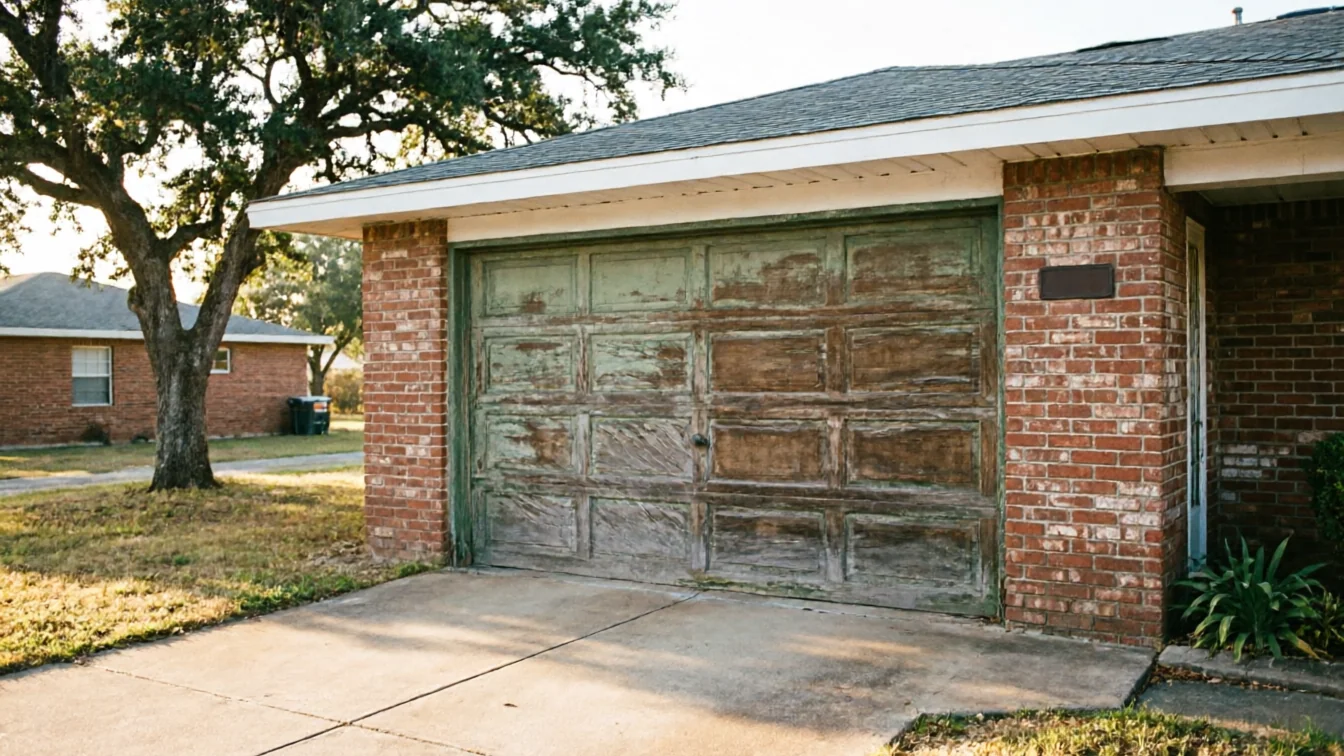
A door from the earlier era is usually a single steel panel on a single torsion spring, with hardware that was never rated for the cycle counts we ask of garage doors now - two, three openings a day for forty years adds up. A 2000s-era door is more likely to have an extension or torsion setup matched to a heavier insulated panel, with an opener that's closer to the end of its own working life than the door itself.
When you call about a door that won't go up, the first question worth answering isn't "what's broken" - it's "which era is this door from, and is the rest of the system aging at the same rate." A spring swap on a forty-year-old door with a dying opener and rusted track isn't a repair, it's a down payment on three more repairs this year.
What It Costs
We're not going to put a number here that isn't backed by a quote, because the right number depends on what's actually failing - spring, cable, opener, panel, or some combination. What we can tell you is how to think about it.
In a part of North Texas where median household income runs around $144,434, we see more owners lean toward full replacement once two systems fail close together, rather than chase parts for an older door piece by piece. That's not us pushing replacement - it's what happens when a torsion spring and a worn-out opener circuit board both go within a season. Fixing each separately usually costs more in labor calls than doing both at once.
The honest limitation: if your door is a 1970s or 80s original panel, some hardware for it is no longer made, and we may not be able to match a part exactly. In that case we'll tell you straight that a patch repair is temporary, not a fix, and let you decide what to do with that information instead of guessing for you.
The Common Mistake
The mistake we see most in Lewisville is treating a cosmetic problem and a mechanical problem as the same decision. A dented panel on a 2000s-era door with good rollers and a healthy spring is worth fixing - that's a panel swap, not a system failure. But a door that's merely noisy, slow, or hard to lift by hand is usually telling you the torsion spring is near the end of its cycle count, and ignoring that because the door 'still works' is how you end up with a snapped spring and a car trapped inside on a Tuesday morning.
The other version of this mistake runs the opposite direction: replacing a perfectly sound door because the opener failed. Across the 2000s-built sections of town, we find plenty of doors with solid tracks and springs sitting under openers that simply wore out - those only need the opener swapped, not the whole system. Knowing which part failed, instead of assuming the whole unit is shot, is most of the job of getting this decision right.
How Local Conditions Play In
Lewisville sits in a moderate-heat climate band, not the extreme end some other parts of Texas deal with, and that shows up in how hardware fails here. Instead of sudden snaps from thermal shock, we more often see torsion springs that stretch and lose tension gradually, and lubricant on rollers and hinges that breaks down and gums up a season or two earlier than the manufacturer's spec sheet assumes. That's a slower failure pattern, which is actually good news - it gives you a warning window most owners miss because the door still opens, just louder and slower every month.
The heat also bakes garage interiors that sit closed most of the day, which stresses opener circuit boards and belt-drive systems faster than the door hardware itself. Our service area runs from Hickory Creek about five miles out to towns like Corinth, Lantana, and Justin further out past the city, and houses across that stretch share the same build era and the same slow-fade failure pattern rather than sudden breaks - which is exactly why catching the early noise matters more than waiting for something to snap.
Frequently asked questions
How do I know if my garage door is too old to repair?
Age alone isn't the test - condition is. A 1970s or 80s door with an intact frame and track can often take a new spring and keep going. The red flags are rust through the track, a warped panel, or hardware that's no longer made. If we can't source a matching part, we'll say so rather than force a mismatched fix.
Why does my door seem to get noisier in summer?
Heat breaks down lubricant on rollers and hinges faster than it would in a cooler climate, and Lewisville's moderate-heat band still means hot garage interiors most of the year. That gradual drying-out is usually the cause of new creaking or grinding, not a sign the spring is about to snap.
Is it worth replacing the opener if the door itself still works fine?
Often yes, especially on 2000s-era homes where the door and track are sound but the original opener has simply aged out. Replacing just the opener is a smaller job than a full system swap, and it's common in this area since door hardware and openers don't always wear out on the same schedule.
Related garage door services in Lewisville
More garage door guides
Book garage door service in Lewisville
Call now or request a quote - tell us what the door is doing and where you are.