
Lewisville, TX · Garage Door Service
What Happens to Your Opener When the Power Goes Out in Lewisville
Most Lewisville garage doors run openers installed when homes went up between 1973 and 2014, so a power outage can strand an aging unit without any warning.
- Repairs & new doors
- Springs & openers
- Serving 7 nearby communities
What Is Going On
Most of the houses in Lewisville's service area went up between 1973 and 2014, with the bulk of that stock dating to around 2000. That matters here because 2000 was right in the middle of the chain-drive, no-battery-backup era for garage door openers. When the power drops, those units stop cold. No chime, no slow-close warning light, nothing. The door just sits wherever it was when the outage hit, which is a real problem if it was mid-cycle and half open.
Across the 23 named areas that make up this market, the housing is mostly 2000s stock, meaning most openers are old enough to be on their second or third circuit board by now, whether or not the board has actually been swapped. A board that's already stressed from age handles a hard power outage worse than a newer one. You'll sometimes see an opener come back on after an outage and refuse to respond to the remote at all, or run through its travel limits like it's never seen the door before. That's not a coincidence tied to the outage itself, it's an old board getting one more jolt it didn't need.
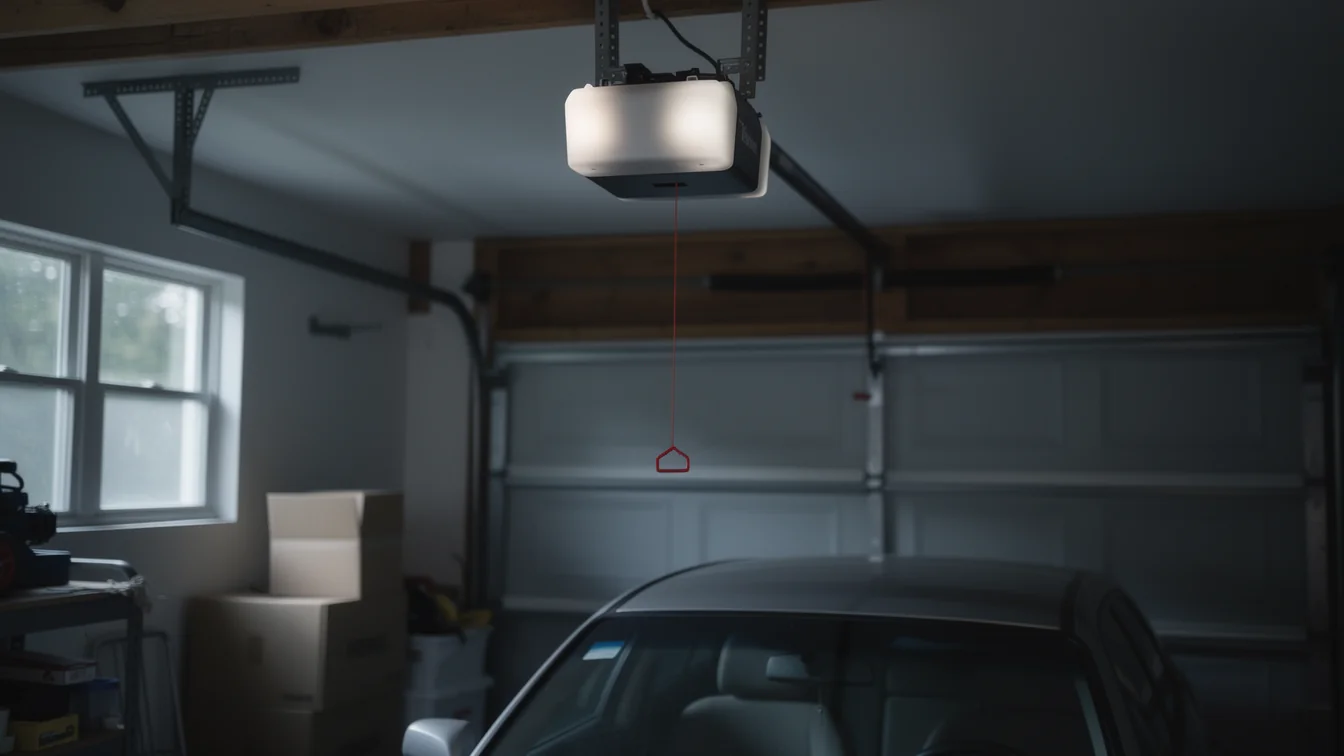
If your opener predates battery backup entirely, the manual release cord is your only way in or out until power's restored or you call someone.
What It Costs
We're not going to put a number here that doesn't match what you'll actually pay, because it depends entirely on what's inside the unit when we open it up. A blown capacitor is a different job than a fried logic board, and a logic board is a different job than just needing the opener reset and re-learned to the remotes. Anyone who quotes you a flat price over the phone before seeing the unit is guessing.
What we can tell you is what drives the cost up or down: whether the opener is old enough that the manufacturer doesn't stock that board anymore, whether the motor itself took damage or just the electronics, and whether you're looking at a repair versus deciding the unit's old enough that replacement makes more sense than chasing parts for it. With a lot of openers in this area original to homes built in the 1973 to 2014 window, that second conversation comes up more than you'd think.
Median household income here sits at $144,434, high enough that battery-backup opener upgrades are a realistic option for most owners, not a stretch. That's worth knowing before you decide whether to repair an old unit or just move to one that won't leave you stuck next time.
The Common Mistake
The mistake we see most is someone assuming the manual release cord will get them out in an emergency without ever having pulled it once before the day they need it. With 57,383 owner-occupied houses in this service area, a lot of garage doors here are tied to openers installed when the subdivision was built, not replaced since, and a cord that's sat untouched for that long can be stiff, mounted wrong, or disconnected from a spring that's also past its service life. Pulling the release on a door with a weak or broken spring doesn't give you a light door to lift by hand, it gives you a very heavy door with nothing holding it up.
The second mistake is treating the opener and the power outage as the whole problem and ignoring the door itself. An outage doesn't care whether your springs, cables, and rollers were already marginal. It just removes the one thing, the motor, that was compensating for them. If the door was already hard to move by hand before the outage, that's the actual issue, and it was there the whole time. Worth checking the door on manual release once, calmly, before you need to.
How Local Conditions Play In
Lewisville sits in a moderate-heat climate band, not the extreme end, but warm enough that heat cycling is the thing wearing out battery packs in backup-equipped openers, not freezing cold the way it would in a northern climate. A battery that sits in a hot garage through repeated warm stretches loses capacity faster than one in a cooler, more stable space, and most owners don't find out until the power actually cuts and the backup doesn't kick in.
The housing age plays in too. Openers from the earlier end of the 1973-to-2014 build range were made before battery backup was even an option on most models, so there's nothing to fail because there was never anything there. Openers from the later end, closer to 2014, are more likely to already have a backup battery, but even those are old enough now that the battery itself may be well past useful life even if the opener's motor is fine.
If you've never tested what your opener does in a dead-power scenario, a planned test, not during an actual outage, tells you more than guessing. It's a five-minute check against being stuck guessing during the real thing.
Frequently asked questions
Will my garage door opener work at all during a power outage?
Only if it has a working battery backup. Chain-drive and older belt-drive openers common in homes built here from the 1970s through the 2000s typically have none, so the motor simply stops. You'll need the manual release cord to open or close the door by hand until power returns.
How do I know if my opener has battery backup?
Look for a battery compartment on the opener housing itself, usually a separate box or integrated unit near the motor head. If the opener predates roughly the mid-2000s, it's unlikely to have one. We can confirm what you've got and whether the battery, if present, still holds a charge.
Is it worth replacing an old opener instead of repairing it after a power outage?
Depends on what failed. A reset or a swapped capacitor is a repair. A fried board on a unit old enough that the manufacturer no longer stocks parts for it is a different conversation. We'll tell you which one you're in before we recommend either.
Does the manual release cord always work?
The cord disengages the opener, but it doesn't fix a weak or broken spring underneath it. If the door feels heavy or won't stay put once released, that's a spring issue, not an opener issue, and lifting it by hand that way can be dangerous.
Related garage door services in Lewisville
More garage door guides
Book garage door service in Lewisville
Call now or request a quote - tell us what the door is doing and where you are.